
Specialty Millwork
Custom Built-In Bookshelves & Home Library Shelving in Lexington, KY
Lexington Custom Cabinets designs and builds custom bookshelves, home libraries, and architectural shelving for homeowners who want storage and display to feel built into the room from the beginning. We plan full-wall libraries, fireplace-adjacent shelving, reading rooms, office bookcases, display cabinetry, and mixed open-and-closed storage around the architecture, collection, and style you want.
Request a free quote
Tell us the room and rough size.
Custom Built-In Bookshelves Lexington KY
The best built-in shelving is as much about proportion as capacity. Shelf spacing, vertical divisions, crown and base details, cabinet doors, lighting, glass, and the relationship to windows or fireplaces all influence whether the finished wall feels refined or busy. We can work in painted millwork, white oak, walnut, cherry, maple, and other premium materials, with profiles and finishes selected to coordinate with the surrounding room.
We design around what you want to display and what you want concealed. Books, art, records, collectibles, media, files, and everyday storage can each be given an appropriate zone without making the wall look like a storage system. Adjustable shelving, lower cabinets, integrated lighting, and custom trim are planned together so the millwork feels cohesive from floor to ceiling.
Lexington's H-1 districts include neighborhoods such as Gratz Park, South Hill, Ashland Park, and Woodward Heights, while ND-1 areas include Chevy Chase and Meadowthorpe. In established homes like these, built-ins often need to relate carefully to existing trim, ceiling height, windows, and fireplaces; in newer rooms, custom shelving can add architectural definition that was not part of the original build.
Types of Shelving We Build
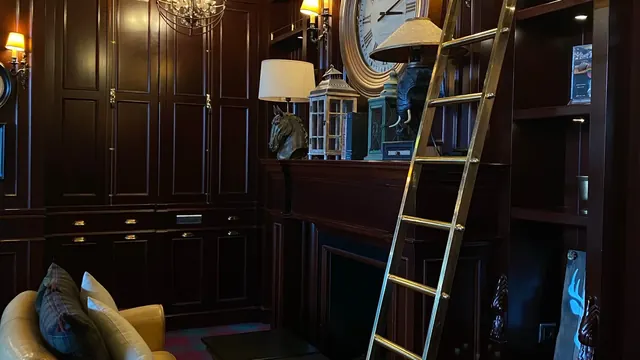
Floor-to-Ceiling Library Walls
A full wall of shelving, usually with a base cabinet run beneath and often a ladder. Suits the tall rooms in Lexington's pre-war districts.
Alcove and Chimney Breast Shelving
Fitted into the recesses either side of a fireplace, which is otherwise awkward space in period houses.
Bookcase and Cabinet Combinations
Open shelving above with closed storage below, which hides the things that are not books.
Under-Stair and Low Shelving
Fitted to the volume under a staircase, or low runs beneath windows where full-height is impossible.
Display and Object Shelving
Deeper, more widely spaced shelving for objects rather than books, which changes both the spacing and the load calculation.
Shelving Features and Accessories
Adjustable Shelf Pins
Shelving on a pin system rather than fixed, so spacing changes as a collection does.
Stiffened Front Edges
An applied edge that increases the effective thickness of a shelf without making the whole shelf heavier. The efficient way to extend a span.
Rolling Ladders
For full-height shelving. Needs a properly rated rail and a floor that will take the wheels, and it is a genuine structural fixing.
Integrated Lighting
Shelf or cove lighting that makes titles readable, wired by a licensed electrician.
Glass Doors
For rare or dust-sensitive books, in tempered glass with shelving sized to the load behind it.
Shelf, Door and Display Options
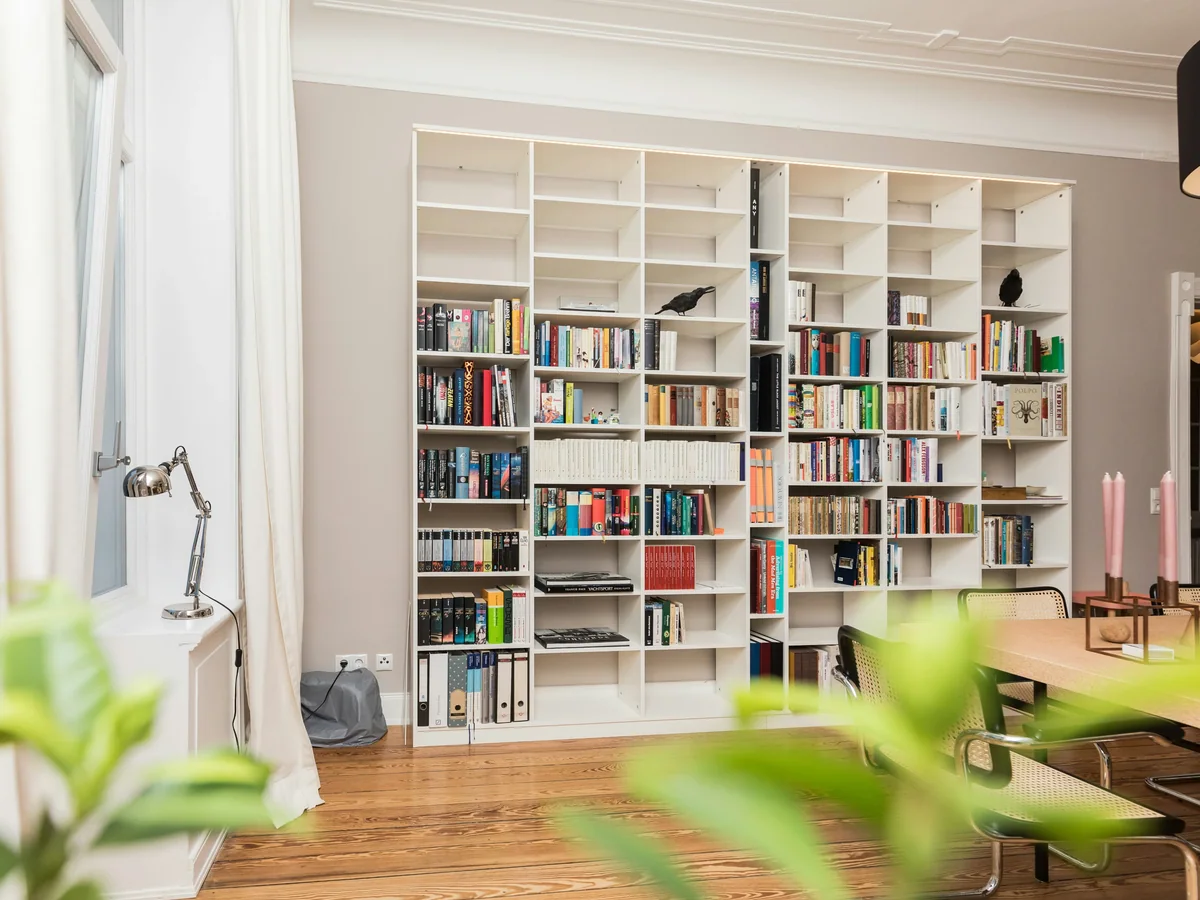
Open Shelving
The default, and what most people want. Books are their own decoration.
Glass-Front Sections
For a portion of a library wall, protecting rare or dust-sensitive volumes.
Closed Base Cabinets
Doors below the shelving for everything that is not a book, which keeps the open shelving looking intentional.
Concealed Door Bookcases
A bookcase that swings to reveal a room behind. Genuinely requested more often than you might expect, and a real hinge engineering problem.
Shelving Materials and Finishes
For shelving, material choice is structural before it is aesthetic. Solid hardwood and quality thick plywood both resist deflection far better than melamine-faced particleboard, which is where most sagging shelves come from. Poplar and maple both work painted; white oak, cherry, and walnut suit a stained library. In Lexington's older houses, matching the existing trim profile is usually the right call, since a library wall is a large surface and a mismatched profile is very visible. Finishes should be low-sheen, because gloss on a large shelving wall produces glare that makes titles harder to read.
Library and Bookshelf Design Directions
Traditional Library
Stained hardwood, full height, crown moulding, and a rolling ladder. Correct in the Federal and Greek Revival houses across the region.
Painted Alcove Shelving
Fitted either side of a chimney breast in a painted finish matched to the room's trim. The most requested version in period houses.
Modern Open Shelving
Slab construction, minimal edges, no visible fixings, often asymmetric. Suits contemporary architecture.
Reading Room
Shelving combined with a window seat or built-in bench, which makes a library a room people actually sit in.
Before We Build Your Shelving
Shelving is a structural project disguised as a decorative one, so field verification focuses on load and on the wall. We confirm:
- What is actually going on the shelves, since hardbacks, paperbacks, and objects load differently
- Bay widths you want versus what the material will carry without deflecting
- Wall construction and stud positions, because a loaded library wall must anchor into structure
- Ceiling height, and whether a ladder is needed to reach the top
- Existing trim profiles where shelving meets baseboard, casing, or a chimney breast
- Floor level, since a tall shelving wall out of plumb is very visible
How Your Shelving Project Works
Measure and weigh the brief
We measure the wall and establish the real load, because bay width follows from what is going on the shelves.
Drawings and samples
An elevation showing bay widths and shelf thicknesses sized to span, plus finish samples matched to existing trim.
Field verify
Stud positions, floor level, ceiling height, and trim profiles confirmed before fabrication.
Build, finish, install
Built and finished off site, then set, scribed, and anchored into structure. Shelves are pinned and checked under load.
Common questions
Built-In Bookshelf FAQs
How long can a bookshelf span before it sags?
How deep should book shelving be?
Can you build shelving into fireplace alcoves?
What material stops shelves from sagging?
Can you add a rolling ladder?
Get a quote on your built-in shelving
Tell us the wall dimensions and roughly what is going on the shelves. Load determines bay width, and bay width determines the whole design.